Between Algorithmic Inspiration and Digital Craftsmanship
In an architectural image, many objects almost go unnoticed. A table, an armchair, a vase, or a few plates often serve to provide scale, suggest a use, or make the space feel more alive. Yet even when they appear secondary, their presence strongly influences how the image is perceived.
An object that is too famous or immediately recognizable can attract all the attention and divert the viewer’s gaze away from the architecture. Conversely, an object that is too ordinary can make the overall image feel duller. Without creating any obvious flaw, it introduces a sense of excessive familiarity, as if we were once again seeing the same furniture and accessories already encountered in countless visualizations.
For this reason, we have developed a specific approach around these elements. The goal is not to accumulate more details or expand our digital libraries, but to create objects capable of bringing a distinct identity to each scene.
This research begins long before modeling. It first emerges through observation and the collection of references.
Understanding What the Algorithm Shows Us
Today, a large part of visual research takes place on Instagram. The platform remembers our interests, analyzes our interactions, and gradually refines the content it recommends.
This system can be particularly effective. When we spend several weeks focusing on certain materials, forms, or specific furniture categories, the feed becomes increasingly relevant. It reveals creators, objects, or visual worlds that traditional searches might never have uncovered.
However, this efficiency also has a downside. Algorithms generally deepen an existing direction rather than challenging it. A fascination with marble and stainless steel can eventually generate an environment almost exclusively composed of these materials. Gradually, certain influences disappear in favor of others.
It therefore becomes essential to pay attention not only to the images themselves, but also to the way they reach us. This means deliberately reintroducing overlooked fields: photography, design, craftsmanship, ceramics, or any other source of inspiration capable of broadening our perspective.
This awareness is necessary because a world fed exclusively by algorithmic recommendations quickly tends to repeat itself. Today, searching for references means not only discovering new images, but also preserving the diversity of our curiosity.
It is within this context that we recently noticed several series of images generated by artificial intelligence. They represented complete interiors populated with objects and furniture featuring a distinctive aesthetic. These creations appeared handcrafted while remaining highly contemporary. They shared a common language without directly resembling existing products or models from traditional libraries.
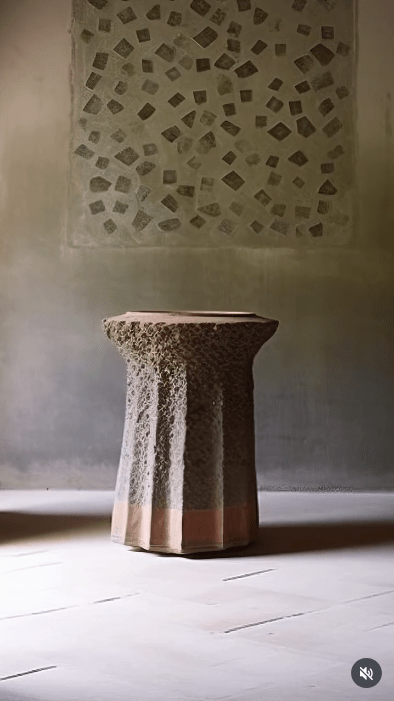
What made them interesting was not only their method of creation, but above all the coherence of the world they suggested.
When the Image Is Not Enough
In a generated image, a piece of furniture can appear perfectly credible. Its shape works, its materials seem realistic, and its design appears obvious.
Yet this obviousness is often superficial.
As soon as the object needs to be reconstructed in three dimensions, many inconsistencies emerge. Some connections are impossible to manufacture, folds stop abruptly, volumes intersect unrealistically, or proportions only work from a very specific angle. Artificial intelligence produces a visual representation, but not necessarily an object that could actually be built.
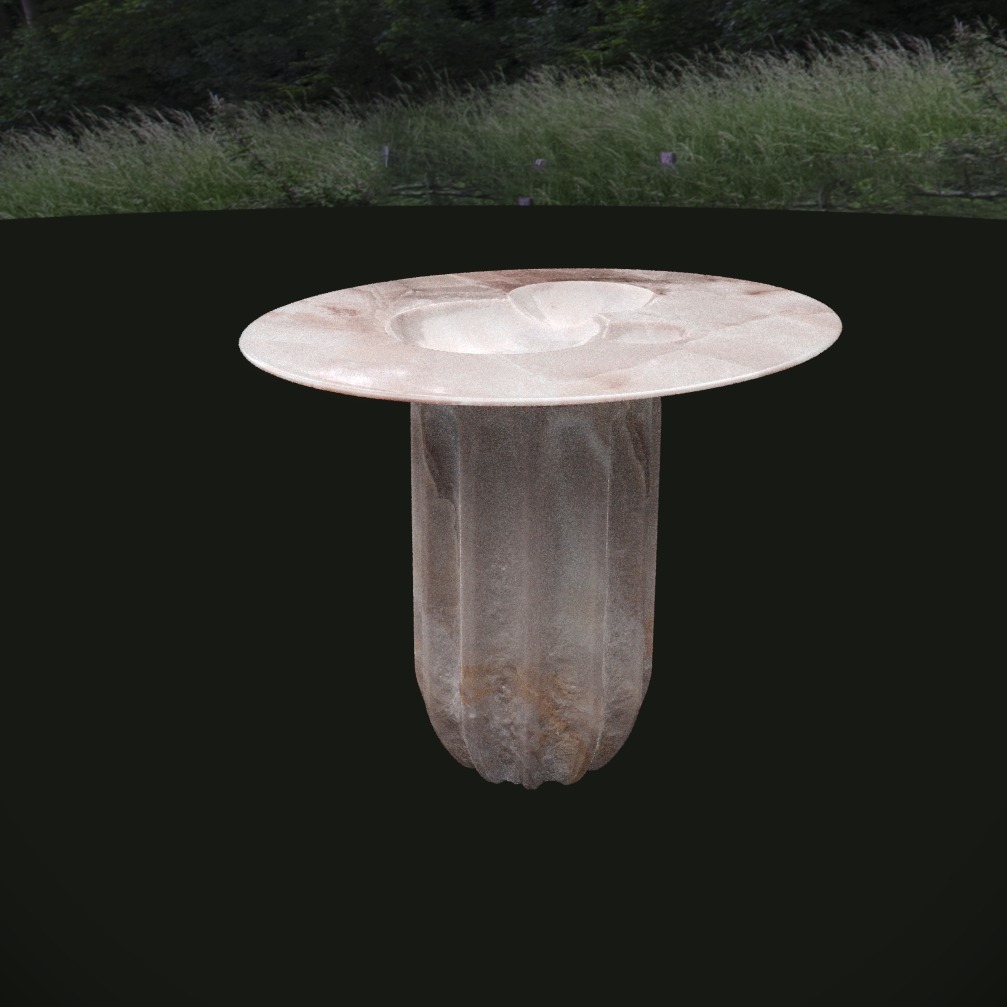
The transition into 3D therefore requires a phase of interpretation. It is necessary to imagine the connections, understand the structural logic, define how volumes come together, and determine how materials could exist in reality. This stage generally requires an initial model in 3ds Max, followed by more detailed work in ZBrush for imperfections, folds, textures, and surface details.
Some objects require several days of work. Although AI tools can now automatically generate 3D geometry from an image, their results remain limited when forms become complex or sculptural.
This slowness may seem contradictory in an era dominated by production speed. Yet it is the very essence of the process. Reconstructing an object is not only about reproducing a shape; it is also about resolving its ambiguities.
At this stage, the work stops being a simple visual translation and becomes a genuine act of design.
Transforming Rather Than Copying
The first model generally remains close to its original inspiration. This fidelity is useful for understanding proportions, volumes, and the principles that structure the object.
But it is only a first step. Once reconstructed, the object can evolve. A dimension can be modified, a material replaced, a shape fragmented, or combined with other elements.
A highly mineral object can acquire a more historical dimension. A dark material can give way to colored marble. A single piece of furniture can be integrated into a complete atmosphere in order to explore different ways of using it.
Gradually, a family of objects develops from the same starting point.
This distinction is important. A singular object is not necessarily unique in the strict sense. Its uniqueness can extend through different variations sharing the same identity while adapting to various contexts.
This approach recalls certain artisanal practices. In a series of handcrafted pieces, the intention remains constant, but each example contains differences. The value lies as much in these variations as in the material or craftsmanship involved.
Digital tools paradoxically allow us to rediscover this logic. Reproduction is easy, but nothing requires us to repeat exactly the same thing. Duplication can become the starting point for a multitude of variations.
The Subtle Impact of the Object
Of course, a vase or an armchair does not transform an architectural image on its own. Its influence is much more subtle. When all elements of a scene are immediately identifiable, the reading becomes predictable. The viewer quickly recognizes the references and instantly understands the visual codes being presented.
The singular object introduces a slight disruption. It feels familiar without being clearly identifiable. Its material appears credible, but its form escapes known catalogs. It does not seek to dominate the image, but it prevents it from falling into usual conventions.
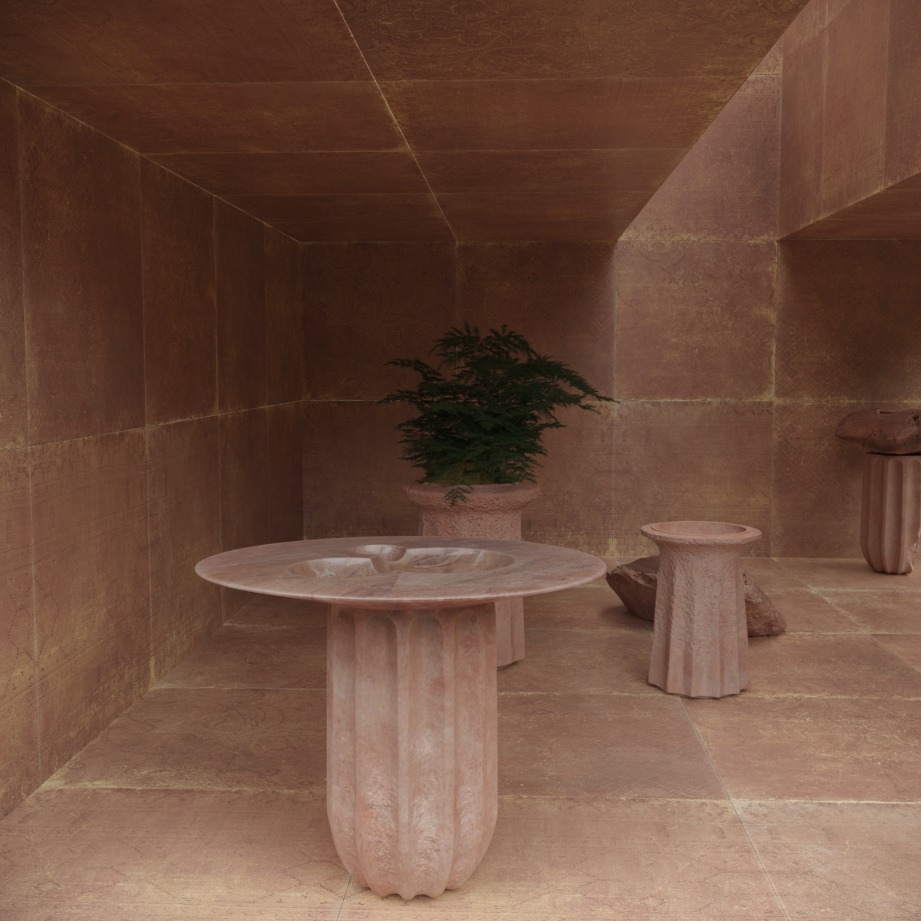
It acts as a discreet resistance against visual homogenization. This difference does not come from a spectacular gesture, but from the accumulation of precise choices: an
unusual proportion, a particular texture, an ambiguous shape, or a detail suggesting a story without fully explaining it.
The aim is not to create strangeness for its own sake, but to make the image more specific and memorable.
Introducing Cultural Memory
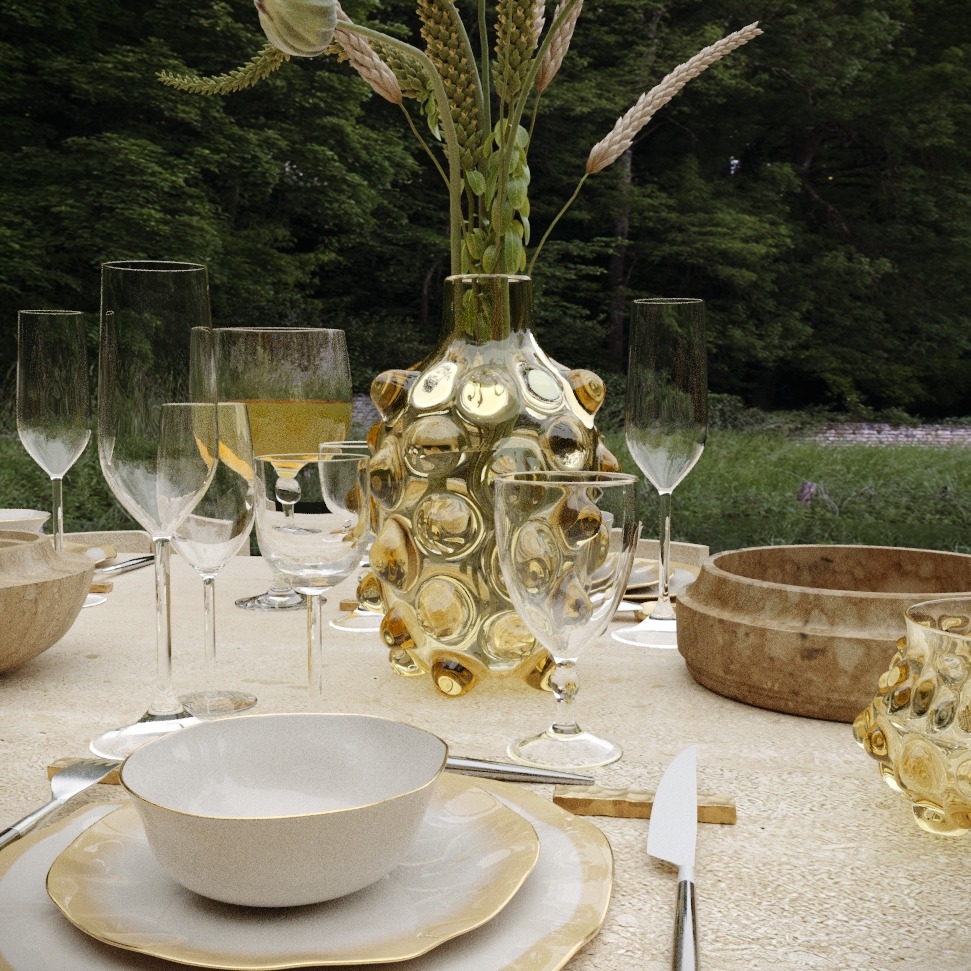
Another series of objects emerged from a photograph by Joel Meyerowitz showing a table after a meal. What attracted attention was not only the composition, but also the colors, the light, and the unusual proportions of the glasses and bowls present in the scene.
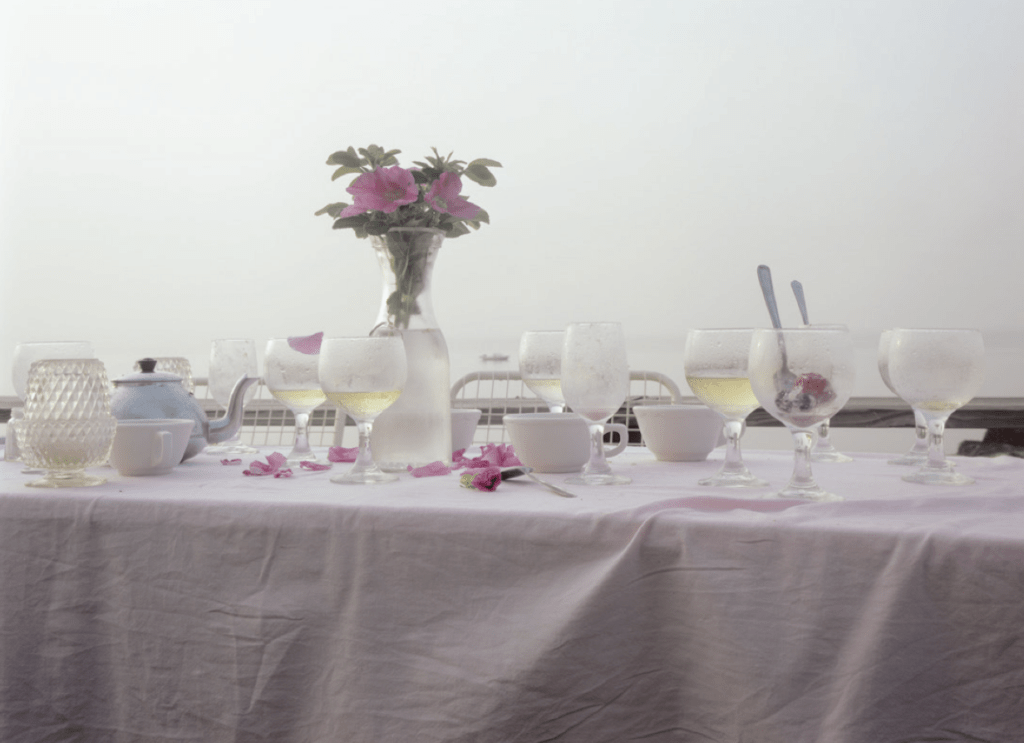
Rather than faithfully reproducing the photograph, certain elements were isolated and reinterpreted. They were transformed so that they could exist in other contexts and become part of new architectural representations without a direct reference to the
original image.
This approach adds another dimension to representation. For most observers, these objects simply contribute to the credibility of the scene. For others, they may evoke a period, an atmosphere, a visual culture, or a photographic memory.
The reference then ceases to be an explicit quotation and becomes a discreet presence integrated into the object itself.
This idea seems particularly interesting to us. An architectural image must remain clear and serve the project it represents. But it can also contain several levels of interpretation, some immediately visible, others almost imperceptible, enriching the
overall depth.
Knowing Where to Take Time
Object libraries remain essential. They allow efficient work and help meet the practical constraints of projects. It would be pointless and unrealistic to reconstruct every element from scratch.
The challenge is therefore not to reject existing resources, but to identify the moments when they reach their limits.
Some images rely mainly on light or composition. Others require specific furniture, a particular material detail, or a unique object to acquire their own character. In these situations, it becomes relevant to slow down and invest more time in creation.
Creating a singular object is not a systematic pursuit of originality. It is a way of preserving the identity of an image and preventing it from becoming interchangeable.
As tools accelerate production processes and references circulate ever faster, uniqueness may lie less in major visual effects and more in modest details to which someone has devoted particular attention.
In architectural representation, the singular object therefore goes beyond the simple role of an accessory. It can become the place where design, visual culture, and a contemporary form of digital craftsmanship meet.